
© Roman Eisele / Wikimedia Commons / CC BY-SA 4.0
.

Auf dieser Seite finden Sie eine Sammlung von Links zu wissenschaftlichen Veröffentlichungen, die für dieses Projekt relevant sind oder die dazu beitragen können, ein tieferes exemplarisches Verständnis über die Prozesse und Umstände zu erlangen, welche möglicherweise in einem Zusammenhang mit der hier vorgestellten Neuinterpretation der Germania Magna stehen. Dabei handelt es sich um Veröffentlichungen unterschiedlicher Forschungsbereiche.

Die Sammlung umfasst:

  • Primärliteratur: Wissenschaftliche Veröffentlichungen, die die Ergebnisse neuer Forschung präsentieren.
  • Sekundärliteratur: Wissenschaftliche Veröffentlichungen, die die Primärliteratur zusammenfassen, analysieren oder interpretieren.
  • Vergleichende Literatur: Veröffentlichungen, die Ihnen exemplarisch ähnliche Prozesse und Umstände in anderen Kontexten aufzeigen.
  • Weitere Ressourcen: Links zu Websites, Datenbanken und anderen Ressourcen, die für die Neuinterpretation relevant sein können.

Die folgenden Publikationen sollen dabei helfen, bestimmte Fragestellungen exemplarisch zu beantworten, welche in einem möglichen Zusammenhang mit den notwendigen Prozessen und Vorgängen stehen, die für eine umfangreiche Landschaftstransformation erforderlich sind. Hierzu zählen beispielsweise Überlegungen über tektonische Bruchereignisse und Rift-Systeme, mit entsprechender Auswirkung auf maritime Rutschungsereignisse und die Entstehung neuer Sedimentationsbecken.


How to reconstruct trends of late Holocene relative sea level: A new approach using tidal flat clastic sediments and optical dating
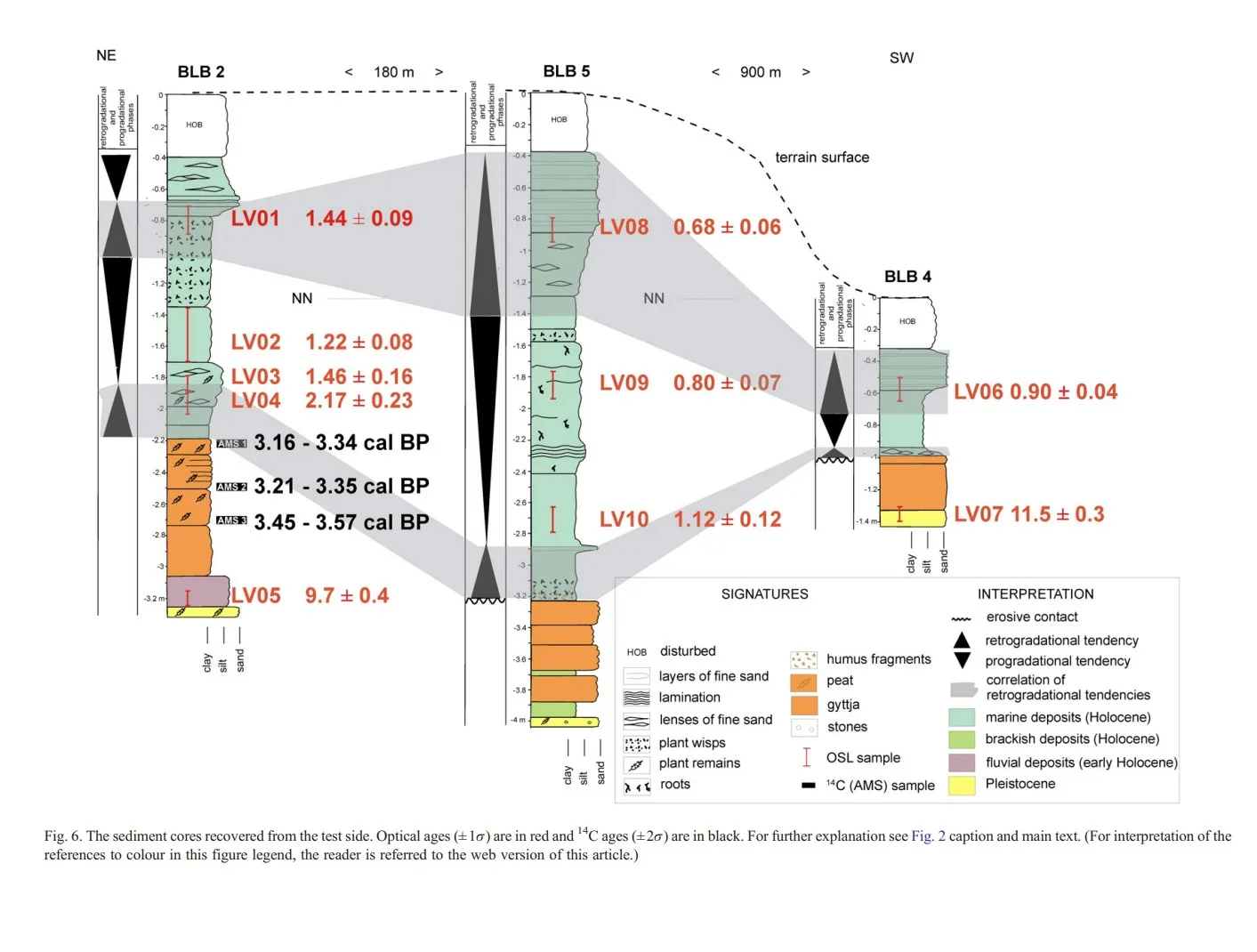

Mauz, B., & Bungenstock, F. (2007). How to reconstruct trends of late Holocene relative sea level: A new approach using tidal flat clastic sediments and optical dating. Marine Geology, 237(3-4), 225-237.

DOI https://doi.org/10.1016/j.margeo.2006.12.001 Abstract Assessment of ongoing relative sea level rise in NW-Europe for individual tidal basins is wanted and, consequently, a variety of methods must be available for investigations under different local conditions. The methodology presented in this paper is based on OSL (optically stimulated luminescence) dating of tidal flat sedimentary records. It uses a conceptual model that assumes that tidal flat clastic sediments record small changes in sea level trend. These changes are in NW-Europe superimposed on the general rising trend of the near-field sea level during the late Holocene (last ∼3500 years). The dating approach can be complemented by 210Pb-dating for the most recent period (last ∼100 years). This combination has the potential to bridge between contrasting short-term and long-term data about sea level change.The paper describes the model for sedimentation and the dating technique. The accuracy of the method is assessed at a test site on the … WeiterlesenHow to reconstruct trends of late Holocene relative sea level: A new approach using tidal flat clastic sediments and optical dating
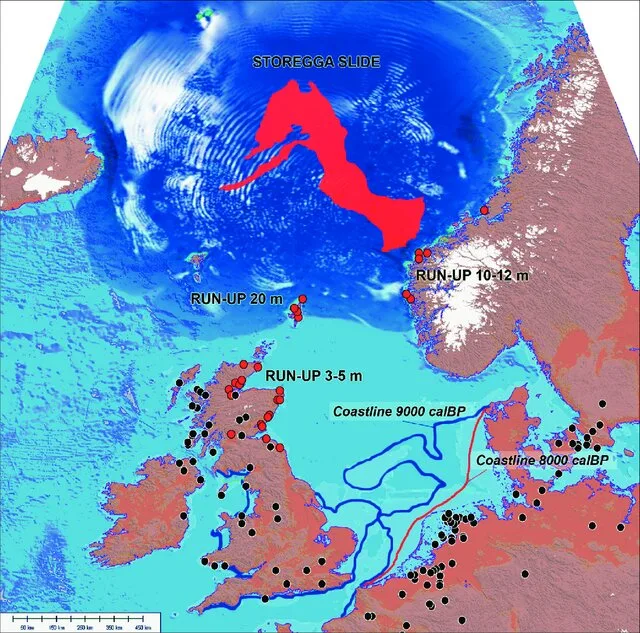
The catastrophic final flooding of Doggerland by the Storegga Slide tsunami


Weninger, Bernhard & Schulting, Rick & Bradtmöller, Marcel & Clare, Lee & Collard, Mark & Edinborough, Kevan & Hilpert, Johanna & Jöris, Olaf & Niekus, Marcel & Rohling, Eelco & Wagner, Bernd. (2008). The catastrophic final flooding of Doggerland by the Storegga Slide tsunami. Documenta Praehistorica XXXV. 34426126. 10.4312/dp.35.1.

DOI https://doi.org/10.4312/dp.35.1 Abstract Around 8200 calBP, large parts of the now submerged North Sea continental shelf (‘Doggerland’) were catastrophically flooded by the Storegga Slide tsunami, one of the largest tsunamis known for the Holocene, which was generated on the Norwegian coastal margin by a submarine landslide. In the present paper, we derive a precise calendric date for the Storegga Slide tsunami, use this date for reconstruction of contemporary coastlines in the North Sea in relation to rapidly rising sea-levels, and discuss the potential effects of the tsunami on the contemporaneous Mesolithic population. One main result of this study is an unexpectedly high tsunami impact assigned to the western regions of Jutland. Weninger, B., Schulting, R., Bradtmöller, M., Clare, L., Collard, M., Edinborough, K., Hilpert, J., Jöris, O., Niekus, M., Rohling, E. J., & Wagner, B. (2008). The catastrophic final flooding of Doggerland by the Storegga Slide tsunami. Documenta Praehistorica, 35, 1-24. https://doi.org/10.4312/dp.35.1

x  Powerful Protection for WordPress, from Shield Security
Diese Website wird geschützt von
Shield Security