DOI http://dx.doi.org/10.61551/gsjfr.54.3.249
Abstract
This study is part of a project that aims to provide the first comprehensive analysis of foraminifera in glacial erratics. Such studies may be used to clarify the origin of glacial erratics and serve as indicators of the direction of glacial movements. The glacial erratics, which were deposited during the Pleistocene Ice Ages, cover vast areas in northern Germany and beyond. The origin of erratics with fossil content can be clarified by correlating them with undisturbed strata. The foraminiferal assemblages of 21 pieces of the glacial erratic Sternberger Gestein (SG) are documented and illustrated. A total of 82 foraminiferal taxa were found, of which 69 taxa were illustrated, representing 97% of the counted specimens. Cluster analysis and analysis of similarities were used to determine the affinities between pieces. Based on previous borehole studies, the fauna in the SG pieces can be correlated regionally with the Palmula oblonga horizon and globally with the Chattian (Oligocene). Indicative are the frequent presence of taxa such as Elphidium subnodosum, Nodosaria intermittens, and Palmula oblonga. Additionally, the absence of marker species commonly found in horizons above and below supports this assignment. The SG assemblages represent an inner sublittoral biofacies that indicates a water depth of less than 50 m.
Michael Hesemann, Dieter Ketelsen; Foraminifera in the glacial erratic rock Sternberger Gestein from northern Germany. Journal of Foraminiferal Research 2024;; 54 (3): 249–263. doi: https://doi.org/10.61551/gsjfr.54.3.249
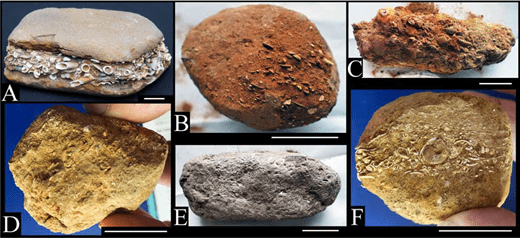
Rock pieces of the glacial erratic Sternberger Gestein, classical sandwich lithological type. Scale bars = 2 cm. A) piece showing three layers, gravel pit at Kobrow. B) KOB_07. C) KOB-11. D) ZAR_01. E) CON_02. F) KOB_12. Pieces B–F were analysed ( Appendix A).
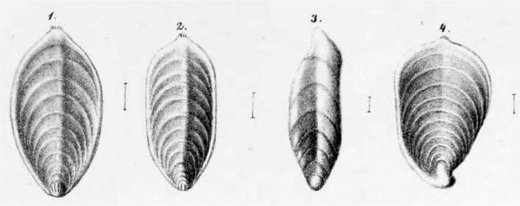
Drawings from 1856 of Palmula oblonga (Roemer, 1838), a characteristic taxon of the Sternberger Gestein (Reuss, 1856).
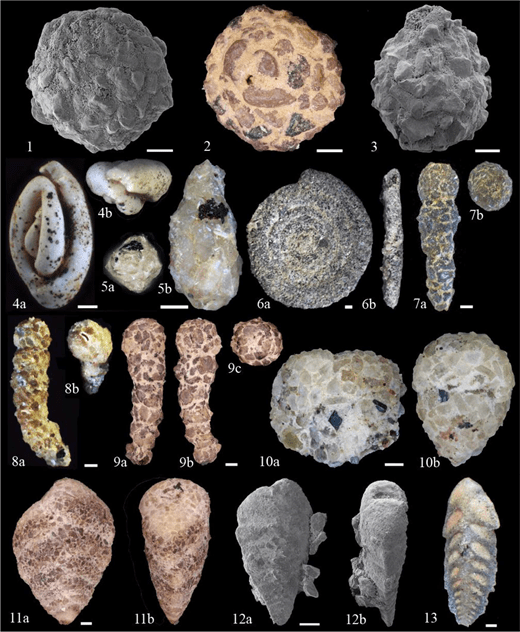
Agglutinated foraminifera of the Sternberger Gestein. Scale bars = 100 µm. 1, 2Psammosphaera fusca. 3Saccammina sphaerica. 4Agathamminoides serpens, 4a lateral view, 4b apertural view. 5Lagenammina arenulata, 5a apertural view, 5b lateral view. 6Ammodiscus incertus, lateral views. 7Reophax regularis, 7a lateral view, 7b apertural view. 8Martinottiella communis, 8a lateral view, 8b apertural view. 9Ammobaculites agglutinans, 9a,b lateral views, 9c apertural view. 10Textularia gramen abbreviata, 10a lateral view, 10b apertural view. 11Textularia gramen, lateral views. 12Spiroplectammina deperdita, lateral views. 13Spirorutilus carinatus, lateral view.
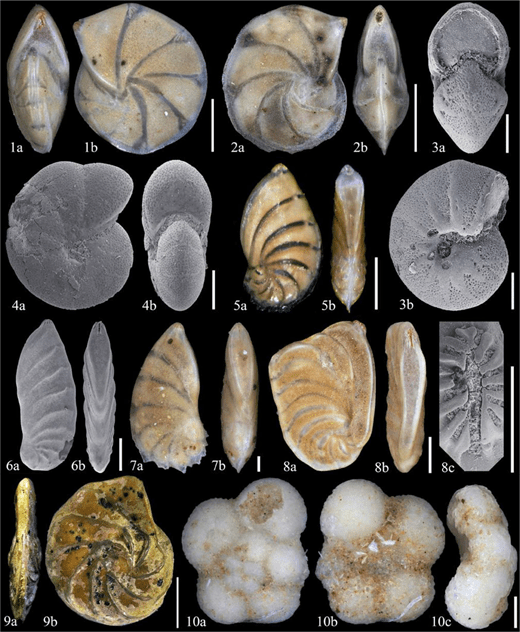
Planispiral and planktonic foraminifera of the Sternberger Gestein. Scale bars = 500 µm except for 3, 4, 7, 8c, 10 = 100 µm. 1Lenticulina inornata, 1a apertural view, 1b lateral view. 2Lenticulina sp., 2a apertural view, 2b lateral view. 3Melonis pompilioides, SEM, 3a apertural view, 3b lateral view. 4Melonis affinis, SEM, 4a lateral view, 4b apertural view. 5Astacolus arcuatus, 5a lateral view, 5b apertural view. 6Astacolus gladius, SEM, 6a lateral view, 6b apertural view. 7Astacolus herrmanni, 7a lateral view, 7b apertural view. 8Astacolus sp., 8a lateral view, 8b apertural view, 8c SEM, apertural detail. 9Planularia sp., 9a apertural view, 9b lateral view. 10Ciperoella anguliofficinalis, 10a spiral view, 10b umbilical view, 10c lateral view.
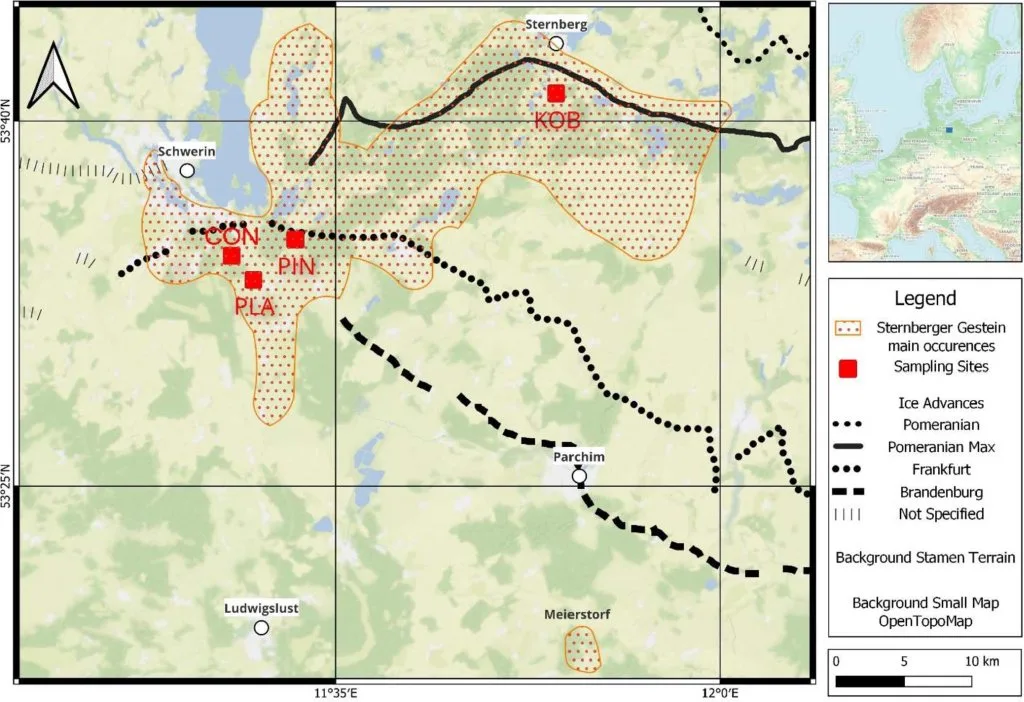
Map of main occurrences of the Sternberger Gestein, Weichselian ice advances, and sampling sites in Western Mecklenburg (Northern Germany). CON = gravel pit Consrade, KOB = gravel pit at Kobrow, PIN = gravel pit Pinnow Ausbau, PLA = gravel pit at Plate. Map redrawn after (Obst et al., 2015; Appendix A). The site at Zarrentin lies 39 km to the West of the site Plate shown on the map.