
a. On Determining the Length of a Ptolemaic Degree
One Ptolemaic degree in Germania Magna is approximately 28 kilometers (or 17.4 miles) wide.
(▶see calculation→)
b. Note on the localization of Aliso near Haltern am See and of Budoris (presumably later Divitia) near Cologne-Deutz: (▶ see calculation→) ( only in German at the moment)
c. Definition of “Dark Earth” as a sudden event deposit: (▶ see testing concept→) ( only in German at the moment)
d. Note on the term “Vistula Fluvius”:
Based on this reinterpretation, the ancient Vistula Fluvius is not identified with the modern Vistula in Poland, but rather as a complex hydrological system located further west in the Lusatia region (the Schwarze Elster (Black Elster)/Spree/Oder system). In contrast, the subsequent transfer of the name to a river located further east (i.e., the modern Vistula) is viewed as a later misinterpretation of ancient records or the result of an erroneous cartographic back-projection in the post-ancient reception of Ptolemaic coordinates.
It is postulated that medieval and early modern scholars, following a settlement hiatus in the 6th century AD (specifically between antiquity and the Middle Ages, as described here→ and by Volkmann (2013)→), attempted to project Ptolemy’s ancient data onto a landscape that had, in the meantime, undergone significant physical-geographical reshaping and whose ethnic-political continuity had also been interrupted. A decisive factor for this eastward “migration” of the name Vistula is thus the demographic break in the 6th century. With the disappearance or departure of Germanic tribal confederations (such as the Burgundians and Lugians) by the end of the Migration Period at the latest, the oral tradition regarding the assignment of the name Vistula to this specific Lusatian river system west of the Oder-Neisse line was severed.
The subsequent Slavic settlement a few centuries later established new hydronyms for the rivers (Elster, Spree), which were now perceived as isolated entities with their respective new courses. The name Vistula initially survived only as a “dead” term in ancient manuscripts, having lost its original point of reference in the landscape.
After the rediscovery of the Geographike Hyphegesis in the Middle Ages, scholars were faced with the task of projecting the ancient image of Germania Magna onto a more modern understanding of Europe. An interim northward shift of the coastline led to the assumption of an excessive north-south extent for Germania Magna. To preserve the geometric aspect ratios of the map (proportionality), cartographers were forced to increase (stretch) the east-west extent accordingly. Through this artificial inflation of the map toward the east, the sought-after Vistula “slipped” on the projected map to coincide with, or at least move closer to, the modern Vistula. The original, more western reference object (the Lusatian system) was literally skipped over and, due to the changes in the landscape, was likely no longer considered a candidate for the ancient Vistula.
The identification of the Vistula with the modern Vistula is therefore based on a coincidence of two historical phenomena: the ethnic discontinuity (hiatus), which erased local topographical knowledge, and a methodologically inadequate cartographic exegesis, in which the preservation of map proportionality under false boundary conditions (the northward shift of the river mouth) led to a massive eastward dilation of the ancient space and the resulting map projection.
It is possible that the Greek term Οὐστούλα (Oustoúla) was originally adopted from Latin (i.e., by the Romans), with even older roots potentially found in the Celtic language or possibly that of the Jastorf Culture.
In Latin, the word ustula is the imperative of ustulō and means “to burn something,” “to scorch something,” or also “to consume something with fire” – here to be understood as an order to someone or something to char or smolder something. There is probably also a closer connection to metalworking (especially charcoal burning), which is particularly indicated by the English cognate ustulate – as an adjective meaning “blackened” or “burnt” (Blackened as if burned) and as a verb directly referring to the “burning or roasting of ores” (actually two different processes).
The naming of the river likely referred originally to the smoldering of wood, or directly to the phenomenon of “smouldering fire” (German: Schwelfeuer), as in a charcoal burner used to produce charcoal for bloomery furnaces. As a corresponding possibility of confusion in English, it also refers to the subsequent smelting process, in which the charcoal actually serves (only) as a fuel (ustulate in English as a verb, therefore incorrectly not in the sense of something “smoldering” or in relation to charcoal burning, but – on the contrary, with a strong flame and maximum oxygen supply! here rather to an (more or less arbitrary) example application of the previously obtained charcoal). In contrast, the adjective refers to the color and burning properties of charcoal (which is therefore black, but still combustible, ustulate in English as an adjective).
In this context, the word “pyrolyze” (from pyrolysis) is probably a modern equivalent for essentially the same process, which was probably already described by ustulō, although here one might also speak of “coking” or “carbonization“.
The current name Schwarze Elster (Black Elster) for part of the historical Vistula Fluvius (Oustoúla) could therefore still be a derivation of the original landscape description from the Germanic or Roman period – a description of the river and settlement landscape and probably also of particular features, such as a foreign visitor could have noticed conspicuously on site (e.g., a cartographer or a Roman military officer).
Perhaps something like this, as in this AI-generated example scenario for a Germanic village situated by a minor tributary of the Vistula Fluvius, producing charcoal for metal extraction. Particularly during winter months, when the days in Germania Magna are short, and the nights are cold, the sight of smoke and fire would have been striking in the frost-laden, marshy landscape. Visitors from distant Greece or traveling merchants passing through from the north, bringing amber jewelry to Rome, were likely accustomed to a warmer, Mediterranean climate and urban life in larger cities. Perhaps here in the cold, there was an impressive experience for such a guest – possibly doubling as a translator and cartographer – and even if communication was not so easy, in this inhospitable area, at one of the many fires in the village, they may have tried to talk about this black wood that looks like it had already been burned. It would have been conceivable, just as it steams and smokes from everywhere. The damp fog that pulls over the field from the meadows and almost completely conceals the forest also suggests it: “There must be a lot of fire in this place.” Perhaps the river itself seemed to boil beneath all that rising smoke, obscuring the entire landscape.
- see The Geography of Claudius Ptolemy in this context
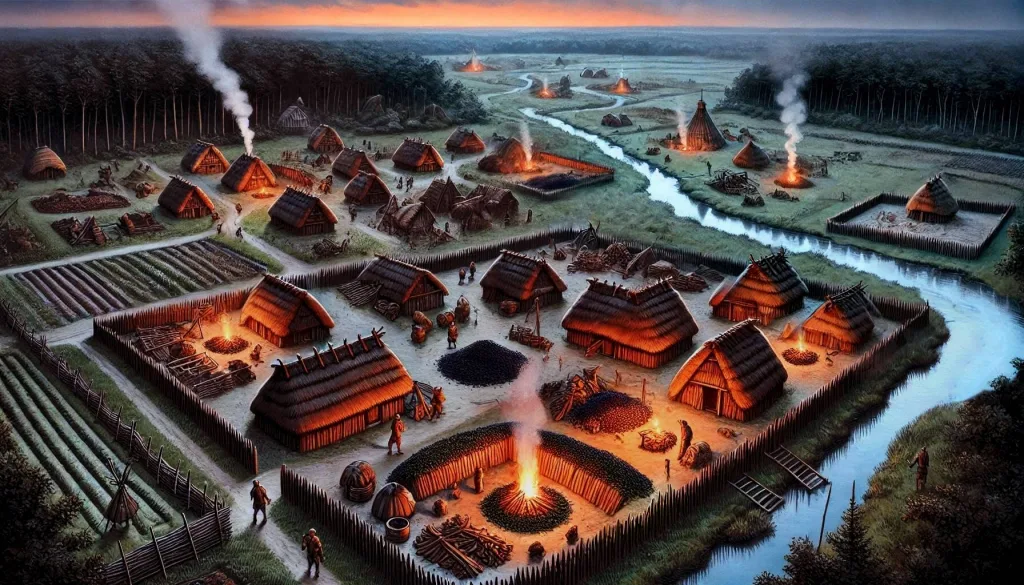
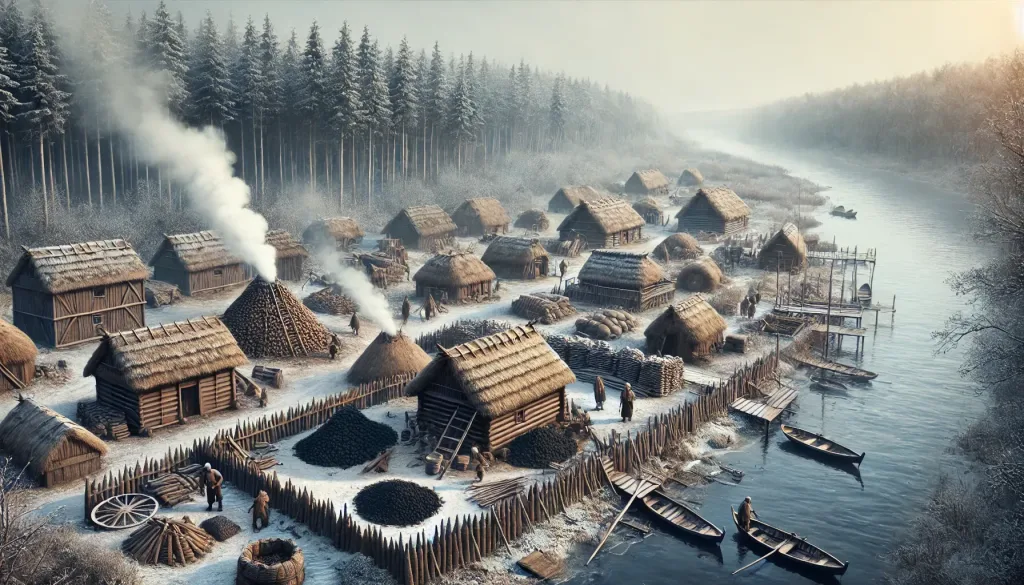
🔊 Vistula Fluvius
Οὐστούλα (Oustoúla)
Conclusion: Thus, we may arrive at a more precise derivation for the Latin ustulō: in the context of charcoal production and use, not only for metal extraction (a connection to English, as outlined above in detail), but also for ritual incense burning (referencing Greek, understood here as “a small form of incense,” cf. frankincense). From Romanian, it could possibly be inferred that the landscape on the Vistula at that time might have been particularly plagued by mosquitoes when the term (per)ustulo entered the language.
Hypothetically, a suitable time frame for such an event could be a period during the (pre-Roman) Iron Age Cold Period, approximately between 900 and 300 BC (see W. Dansgaard et al., One Thousand Centuries of Climatic Record from Camp Century on the Greenland Ice Sheet. Science 166, 377-381 (1969). DOI: 10.1126/science.166.3903.377→), with potentially colder climatic conditions than during the Little Ice Age of the later Middle Ages. The demand for firewood by Nordic civilizations and island inhabitants, who may have settled closer to the Arctic Circle (or generally in colder areas less favored by the Gulf Stream), could have exceeded the local tree resources due to this cooling. As a result, the import of fuel from southern regions might have become necessary. Charcoal, having a significantly lower volumetric weight compared to wood, could have been the preferred material for transport to the north, initially by boat and later, likely on foot.
Naturally, these are highly speculative assumptions intended to support the etymological derivation of ustulō. However, it could serve as additional evidence for the previously hypothesized convergence and cultural exchange between members of the Latin (or proto-Latin) and Finno-Ugric language families, which may have influenced each other in this region. Possibly as early as the early Iron Age (see Hallstatt culture), coinciding with the beginning of charcoal use for iron production in bloomery furnaces (at the geographical language border between the two language families).
The bloomery (or the use of the bellows to kindle the fire from the glowing charcoal) could be symbolic in this context for the Sampo forged by Ilmarinen, at least on a smaller scale – in a worldly sense. As a reflection of cosmic forces that in their entirety, however, elude our imagination.
Additional Media References:
- Video example for charcoal fire
- Sampo (Film, Sowjetunion, Finnland, 1959)
- Rauta-Aika (The Age of Iron, 1982)
- Map of Celtic Settlement in Europe, between 800 und 300 BC., (Wikipedia-DE: Hallstattzeit)
- The Forging of the Sampo by Väinö Blomstedt [fi], 1897, (Wikipedia-EN: Sampo)
- The Forging of the Sampo, tempera by Joseph Alanen, 1910–1911, (Wikipedia-EN: Ilmarinen)
- Stadt Elsterwerda (Hrsg.): Wo einst Germanen siedelten – Ausgrabungen im Gewerbegebiet-Ost in Elsterwerda (Flyer)
- Archäologische Ausgrabungen, 1992 in Elsterwerda, Stadtfernsehen Elsterwerda/EEF 1992/2016
- Zbigniew Gołąb, The Origins of the Slavs: A Linguist’s View (Columbus, 1992), concerning whether the Veneti on the north-eastern border of Germania Magna might have belonged to the Italo-Celtic branch of languages [4]
- Jadranka Gvozdanović (2012), On the linguistic classification of Venetic, University of Heidelberg
- See also the Russian-language Wikipedia article on the Veneti and Wends on the topic of “Celts or Illyrians,” from
Aleksakha, Andrey Grigor’evich. “Происхождение славян. Прогрессологическая реконструкция.” (The Origin of the Slavs. A Progressological Reconstruction.) Гуманитарный журнал (Humanitarian Journal), No. 1, 2012, pp. 57-72:
“As already mentioned, the Lusatian culture was a culture of the historical community of Urnfield cultures, which originated in the Carpathian-Danubian basin. South of the Carpathians, the area of the Lusatian culture included the territory of the Czech Republic. It is obvious that the population that formed the Lusatian culture on the territory of Poland, East Germany, and Volhynia came to these areas from the Czech Republic or adjacent lands. However, we must not forget that monuments of the Corded Ware culture were found in these areas. Therefore, it is quite possible that the speakers of some languages that belonged to the Corded Ware culture lived for some time in the northern part of the Carpathian-Danubian basin, where, as mentioned above, representatives of another group of Indo-European languages settled, namely the ancestors of the Italics, Celts, Illyrians, and Veneti, who later founded the Urnfield culture community.
There is a hypothesis that links the ethnonym “Wends” with the Celts or Illyrians. The ethnonym “Wends” is known on the Adriatic coast. The current Italian province of Veneto and the city of Venice are named after the Veneti people. In addition, Julius Caesar reports on the Veneti in Gaul (modern-day France). Strabo already knew about the emergence of the Celts (Gauls) as a people in the Danube basin. Consequently, the ethnonym “Wends” or “Veneti” was originally characteristic of the inhabitants of the Carpathian-Danubian basin. Later, with the migrations of the Celts, the Veneti appear on the territory of France.
However, archaeological data also points to migrations of the Celts to Poland. Later, the Celts in Poland were assimilated by the Przeworsk culture, but the influence of the Celts on the Przeworsk culture was very strong. We cannot say anything about the influence of the Celts on the language of the Przeworsk people, but the Gothic language, which inhabited northern Poland, has quite a few Celtic borrowings. It can be assumed that there were even more of them in the language of the Przeworsk population, which was in direct contact with the Celts. Even the name of the Przeworsk tribes, about whom Tacitus writes, the Lugii, is undoubtedly of Celtic origin. Lug is the Celtic sun god. For example, the city of Lugdunum (today’s Lyon) is actually the city of Luga or Lugograd. At least some of the southern Przeworsk tribes could have received the name “Wends” from the Germans.
Later, when the Przeworsk people moved to Volhynia and Transnistria, the name “Wends” was transferred to the Slavs who assimilated them. This hypothesis could explain the fact that Jordanes, who used Gothic sources, considers the Wends to be Slavs, while the Byzantine Procopius of Caesarea, who wrote about the Slavs at the same time, does not report anything about the Wends. The Przeworsk people and later the Slavs could have been called Wends by the Goths. That is why this name was adopted in the German language for the West Slavs in the form “Wenden” and from them passed to the Finns, Estonians, and Karelians in the form “Vene” as a designation for the Russians. A number of authors link the name of the Wends with the mythical people of the Vanir from Germanic mythology.
It seems to me that the transfer of the ethnonym “Venedi” from the Celts first to the Przeworsk people and then from them to the Slavs is confirmed by an interesting fact: the Przeworsk population had the custom of not only burying men with weapons but also ritually breaking or bending them beforehand. In addition, archaeologists have documented this custom among the Celts even earlier (Kostrzewski s.228), and it arose again at the end of the 6th – 5th century BC (Mongait since 186). Linguists admit that it is precisely with this tradition that the Slavic word group “death,” “perish” (Trubachev 1991, p. 42) is connected. It is possible that this happened. The Slavic reinterpretation of a Celtic custom through Germanic mediation. Another example of the Celtic influence on the Slavs through the Germanic language is the word “tyn,” which belonged to the common Slavic language. Linguists believe that this word comes from the Celtic dun meaning “palisade,” “fence”. This word was a component of the Celtic names of many cities, for example, the aforementioned Noviedun, i.e., New Town, and Lugdunum. However, the fact that this word entered Slavic in the form “tyn” indicates that it was borrowed from a Germanic language with the typical German sound shift from “d” to “t” (Filinc.136).
There are therefore good reasons to believe that at the beginning of our era, the Slavs had close contacts with the East Germans who were exposed to a strong Celtic influence. Consequently, the ethnic name “Wends” could well have been transferred to a part of the Przeworsk population and then to the Slavs who assimilated these Germans in Transnistria. This is precisely why the Goths had the impression, as Jordanes conveys, that the Slavs descended from the Wends.”
– last accessed on September 14, 2025, revised here by S. Mildner
References:
– Gaius Julius Caesar. Commentarii de Bello Gallico. – Book III, 8–16.
– Strabo. Geographica. – Book IV, 4,1; V, 1, 4.
– Kukharenko, Yu. V. Arkheologiia Pol’shi (Archaeology of Poland). Moscow, 1969. – pp. 101-104.
– Tacitus. Germania. — Section 43.
According to this derivation, within the drainage basin of the Vistula Fluvius, the following designations—in addition to the “Lugii” and possibly the “Veneti” mentioned above—could potentially have a connection to the Celtic language or originate from there in earlier times:
- The settlement “Lugidunum”, possibly near Falkenberg/Elster (see map overlay→)
- The settlement “Carrodunum”, possibly near Bernsdorf or Kamenz (see map overlay→)
- The tribe “Luti Diduni”?, possibly in the Lower Lusatia region (see map overlay→)
Furthermore, there are tentative indications that the following tribal names within the catchment area of the Vistula Fluvius have a connection to Celtic, suggesting they may have culturally and linguistically influenced their Germanic neighbors in this region:
- The Avarini, also known as Anartians or Anartes (or Anarti, Anartii, or Anartoi), possibly located on the border of Germania Magna in the area of present-day Lubusz Land (see map overlay→), were Celtic tribes or—in the case of subgroups of the Anartes who advanced into the ancient region of Dacia (roughly modern-day Romania)—Celts who were culturally assimilated by the Dacians.
- The Ombrones, also Ambrones (Ancient Greek: Ἄμβρωνες), possibly located in eastern Lower Lusatia near Forst or Cottbus (see map overlay→), were an ancient tribe mentioned by Roman authors. Some believe they were a Germanic tribe from Jutland; however, the Romans were unclear about their exact origin. Plutarch mentions Ambrones as a name for the Ligurians. A possible corruption of the Germanic Amr– to Ambr– by Roman sources makes the attribution even more uncertain. The Proto-Celtic word ambi– means “around” (cf. Ambigatus, Ambiorix, Ambiani, and Ambisagrus). While the Ambrones are generally classified as a Germanic tribe, Celtic influences have also been suggested, though this remains controversial.
- The Anartophracti, likely even identical to the Anartians (Avarini) further north, possibly from the Upper Lusatia region near Weißwasser or Bad Muskau (see map overlay→), are an ancient ethnic group of eastern Central Europe about which little is known for certain. The name Anartes appears in Caesar’s De Bello Gallico, where they are localized at the eastern edge of the Hercynian Forest, which extended to the Dacians and Anartians (ad fines Dacorum et Anartium).
Along with the
- Cotini (Gothini), the Anartians are named as one of the conquered gentes in the partially poorly preserved “Elogium of Tusculum.” According to Tacitus, the Gotini mentioned in the inscription were a Celtic-speaking people; the Dacians (presumably descending from the Thracians) settled in the western Black Sea region and expanded as far as Moravia during Caesar’s time.
Following the collapse of Burebista‘s Dacian Kingdom in 44 BC, the names of several presumably Celtic ethnicities appear in the sources: alongside the Osi, Cotini, and Teurisci, also the Anartii. On Donnus Nikolaus Germanus’s map of Germania Magna, the Cotini appear as Cogni, near the Königsbrück Heath, possibly near Radeburg or Thiendorf, north of Dresden (see map overlay→).
Tacitus makes a definitive statement regarding the language of the Cotini: Cotinos Gallica (…) lingua coarguit non esse Germanos (“The Gallic language of the Cotini proves they are not Germans”). An etymology for the tribal name is also most likely to be found in Celtic. Although not yet definitively established, it is plausible to recall common personal and place names in Gaulish featuring the element cot- (possibly including Cottbus?). In contrast, Ernst Schwarz attempted to assign the tribal name to the “Venetic” language, regarding which current research tends to speak of “an otherwise unattested West Indo-European language.” In the Venetic of northern Italy—Venetic proper—no connection for Cotini has been found to far. No related linguistic relationships linking the Cotini with Venetic can be reconstructed—neither from linguistic remnants of the previous population, nor regarding pre-Germanic or pre-Indo-European elements, a superstrate language, or linguistic influences during the Migration Period.
Regarding the Cotini, Tacitus further notes that they were engaged in iron mining. According to Ptolemy, the iron mines were located south of the Quadi (and thus, according to the present interpretation, in the area of the Ore Mountains [Erzgebirge]). Numerous traces of small-scale iron metallurgy dating to the Roman Imperial period have been found in settlement areas within Germania Magna. Finds of bloomery furnaces from this period also exist in settlements in Bohemia and Moravia. Regarding the simple, widespread iron smelting technology of the Celts and Germans, hundreds of iron smelters with thousands of furnace remains have been excavated. Even large smelting districts with thousands of slag-pit furnaces processing local bog iron ore have been discovered. According to Radomír Pleiner, iron smelting was primarily a cottage industry that—though specialized—supplied its products to small circles of consumers. To the Romans, this iron economy must have appeared primitive. However, archaeological findings indicate that iron smelting centers also existed in Germania Magna which supplied broader circles beyond the limits of individual farmsteads. Such iron smelting centers as those in Góry Świętokrzyskie and Masovia are fundamentally different from these areas. Production in these centers was obviously so extensive that significant exports must be assumed.
References:
• Ptolemaios, Geographike, 2, 11, 10: Πάλιν ὑπὸ μὲν τοὺς Σέμνονας οἰκοῦσι Σιλίγγαι, ὑπὸ δὲ τοὺς Βουργούντας Αοῦγοι οἱ Ὀμανοὶ, ὑφ᾽ οὓς Λοῦγοι οἱ Διδοῦνοι μέχρι τοῦ Ἀσκιβουργίου ὂρους; ὑπὸ δὲ τοὺς Σιλίγγας Καλούκωνες ἐφ᾽ ἑκάτερα τοῦ Ἅλβιος ποταμοῦ, ὑφ᾽ οὓς Χαιρουσκοὶ καὶ Καμαυοὶ μέχρι τοῦ Μηλιβόκου ὄρους, ὧν πρὸς ἀνατολὰς περὶ τὸν Ἄλβιν ποταμὸν Βαινοχαῖμαι, ὑπὲρ οὓς Βατεινοὶ, καὶ ἔτι ὑπὲρ τούτουσς ὑπὸ τῷ ἀσκιβουργίῳ ὄπει Κορκοντοὶ καὶ Λοῦγοι οἱ Βοῦποι μέχρι τῆς κεφαλῆς τοῦ Οὐιστούλα ποταμοῦ· ὑπὸ δὲ τούτους πρῶτοι Σίδωνες, εὶτα Κῶγνοι, εὶτα Οὐισβούργιοι ὑπὲρ τὸν Ὀπκύνιον Δρυμόν.
• Maximilian Ihm: Cotini. In: Paulys Realencyclopädie der classischen Altertumswissenschaft (RE). Band IV,2, Stuttgart 1901, Sp. 1676.
• Günter Neumann: Cotini. In: Reallexikon der Germanischen Altertumskunde (RGA). 2. Auflage. Band 5, Walter de Gruyter, Berlin/New York 1984, ISBN 3-11-009635-8, S. 100. (books.google.de).
• Tacitus, Germania 43.
• Alfred Holder: Alt-celtischer Sprachschatz. Band 1, 1896, Sp. 1142. (Nachdruck 1961). Personennamen: Cotinius CIL 3, 5625, Cotus CIL 3, 4366; Ortsnamen: Cotinacum.
• Ernst Schwarz: Deutsche Namenforschung. Band 2. 1950, S. 101.
• Johann Kaspar Zeuß: Die Deutschen und die Nachbarstämme. München 1837, S. 123 (books.google.co.uk).
– Seite „Cotini“. In: Wikipedia – Die freie Enzyklopädie. Bearbeitungsstand: 5. August 2025, 22:29 UTC. URL: https://de.wikipedia.org/w/index.php?title=Cotini&oldid=258621802 (Abgerufen: 14. September 2025, 21:47 UTC), hier überarbeitet von S. Mildner